
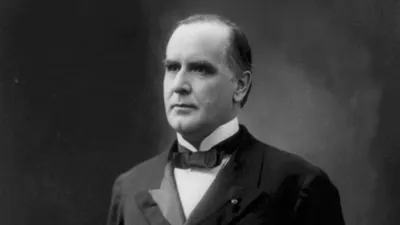
The Presidency of William McKinley: A Comprehensive Overview

juteralabs.com – William McKinley served as the 25th President of the United States, from 1897 until his tragic assassination in 1901. His presidency marked a critical turning point in American history, characterized by economic growth, international expansion, and increasing tensions that would later lead to the 20th century’s global conflicts. McKinley’s time in office also set the stage for significant changes in U.S. domestic policies and foreign relations. This article provides a comprehensive overview of McKinley’s presidency, analyzing his early life, rise to power, key policies, and legacy.

Early Life and Political Career

Early Life and Education

William McKinley was born on January 29, 1843, in Niles, Ohio, into a family of modest means. His father, William McKinley Sr., was a businessman, and his mother, Nancy Allison McKinley, was a devout Methodist. McKinley attended public schools before enrolling at Allegheny College in Meadville, Pennsylvania. He was a diligent student, though he struggled academically at times due to health issues. McKinley eventually left college to serve in the military during the American Civil War, where he distinguished himself as a brave and capable officer.

Military Service

McKinley’s military service during the Civil War played a crucial role in shaping his character and political career. He enlisted as a private in the 23rd Ohio Volunteer Infantry, quickly rising to the rank of major. He fought in several key battles, including the Battle of Antietam, and his bravery earned him recognition. McKinley’s military experience became a cornerstone of his political identity, later positioning him as a leader who understood the hardships of war and the importance of a strong national defense.

Political Ascent

After the war, McKinley entered law and politics, quickly establishing himself as a talented orator and a committed Republican. He was elected to the U.S. House of Representatives in 1876, where he would serve for several terms. McKinley’s support of protective tariffs, which shielded American industries from foreign competition, helped build his reputation within the Republican Party. He later served as the governor of Ohio twice, from 1892 to 1896, where his policies focused on economic recovery and promoting industrial growth.

McKinley’s Rise to the Presidency

The Election of 1896

In 1896, McKinley emerged as the Republican candidate for the presidency, after securing his party’s nomination through his reputation for economic conservatism and strong leadership. His opponent, William Jennings Bryan of the Democratic Party, advocated for the free coinage of silver and more progressive reforms, including direct election of senators. The election was deeply divided along economic lines, with McKinley’s pro-business stance appealing to industrialists and urban workers, while Bryan’s populist message resonated with farmers and rural Americans.

McKinley’s campaign was characterized by a new kind of political strategy—his supporters coined the term “front porch campaign,” where McKinley stayed at home in Canton, Ohio, and communicated directly with voters through speeches and rallies. Bryan, in contrast, embarked on a whistle-stop tour across the country, engaging in a grueling schedule of public appearances. Despite Bryan’s energetic campaign, McKinley won the election with 271 electoral votes to Bryan’s 176, marking a decisive victory for the Republican Party.

McKinley’s Inauguration and Early Challenges

McKinley was inaugurated as president on March 4, 1897, amid a time of national economic depression, widespread labor unrest, and increasing global competition. The new president faced immediate challenges, including the need to restore confidence in the American economy, resolve conflicts with labor unions, and assert American influence abroad. His leadership would prove pivotal in navigating these crises and shaping the future of the nation.

Key Policies and Domestic Achievements

The Dingley Tariff and Economic Recovery

One of McKinley’s most significant early acts as president was his support for the Dingley Tariff of 1897, which increased duties on imports to protect U.S. industries from foreign competition. The tariff was a major piece of legislation that reflected McKinley’s long-standing belief in protective tariffs as a means to support American workers and businesses. Despite initial opposition from Democrats and some factions within the Republican Party, the tariff passed and helped stimulate economic recovery during McKinley’s first term.

In addition to the tariff, McKinley’s administration also worked to stabilize the U.S. economy by maintaining the gold standard, which was seen as essential for ensuring long-term fiscal stability. The gold standard helped restore confidence in the U.S. dollar and allowed for a more predictable financial environment.

The Spanish-American War and American Expansionism

Perhaps the most defining moment of McKinley’s presidency was the Spanish-American War in 1898. This brief but significant conflict marked the emergence of the United States as a global imperial power. Tensions had been rising between the U.S. and Spain over the situation in Cuba, which was fighting for independence from Spanish rule. McKinley initially sought a diplomatic solution to the crisis but ultimately authorized military action following the explosion of the U.S. battleship Maine in Havana Harbor in February 1898, an event that fueled public outrage.

The war, lasting only a few months, resulted in a resounding victory for the United States. Spain relinquished control of Cuba, Puerto Rico, Guam, and the Philippines, thus expanding U.S. territorial holdings in the Caribbean and the Pacific. The war also increased McKinley’s popularity, solidifying his reputation as a strong and decisive leader.

The Philippine-American War and Controversy over Imperialism

The annexation of the Philippines, however, created a new set of challenges for McKinley’s administration. While many Americans supported the idea of imperialism, others, including prominent anti-imperialists such as Mark Twain, criticized the annexation of the Philippines, arguing that it violated American principles of self-government and liberty. The Philippine-American War erupted in 1899 as Filipino nationalists fought for independence, and the conflict would drag on for several years, ultimately resulting in the Philippines becoming a U.S. colony.

McKinley faced significant domestic opposition to his foreign policy decisions, but he defended American imperialism as a means to bring civilization, democracy, and economic opportunity to the Philippines and other territories.

McKinley’s Second Term and Assassination

Re-election and Domestic Challenges

McKinley was re-elected in 1900, defeating William Jennings Bryan for the second time. His second term was marked by continued economic growth and the consolidation of U.S. power on the world stage. McKinley’s administration focused on expanding American influence in Asia, particularly through the Open Door Policy, which aimed to ensure equal trading rights for all nations in China. The policy reflected McKinley’s belief in free trade and his desire to prevent any single power from dominating the region.

However, McKinley’s second term was cut short by his tragic assassination. On September 6, 1901, while attending the Pan-American Exposition in Buffalo, New York, McKinley was shot by anarchist Leon Czolgosz. He succumbed to his wounds on September 14, 1901, leaving Vice President Theodore Roosevelt to assume the presidency.

Legacy and Conclusion

McKinley’s Impact on U.S. Foreign Policy

McKinley’s presidency had a profound impact on the United States’ position in the world. His leadership during the Spanish-American War marked the beginning of an era of American imperialism, with the U.S. becoming a major player in global affairs. The annexation of the Philippines, Puerto Rico, and Guam expanded American influence and military presence, while the Open Door Policy in China set the stage for U.S. involvement in the Pacific.

McKinley’s Domestic Legacy

Domestically, McKinley’s presidency helped lay the groundwork for the economic prosperity of the early 20th century. His support for protective tariffs, the gold standard, and industrial growth fostered an environment of stability and growth. However, his policies also contributed to the growing divide between the industrialized Northeast and the agrarian South and West, tensions that would play out in future elections.

McKinley is often remembered as a president who navigated a rapidly changing world with pragmatism and decisiveness. His assassination, however, robbed the nation of a leader who might have further solidified America’s place as a global power.

In conclusion, the presidency of William McKinley was a pivotal chapter in American history. His administration laid the foundation for the United States’ rise as a global power and shaped the course of domestic and international policies that would define the early 20th century. McKinley’s legacy is a mixture of accomplishments and controversies, but his leadership in a time of great change remains a defining feature of his presidency.

Ulysses S. Grant and the American Experiment

juteralabs.com – Ulysses S. Grant is one of the most pivotal yet paradoxical figures in American history. Known primarily for his decisive military leadership during the Civil War, Grant’s presidency—often overshadowed by the scandals of his administration—deserves a closer examination, particularly in the context of the broader American Experiment. His life and career illustrate the dynamic struggle to define what it meant to be American, especially in the wake of the Civil War, Reconstruction, and the burgeoning industrial age. This article delves into Grant’s legacy, examining his contributions both as a military leader and as a president, and considers how his actions and decisions influenced the direction of the United States during a time of national transformation.

The American Experiment and Ulysses S. Grant

At its core, the American Experiment refers to the ongoing project of creating a nation rooted in democratic ideals, freedom, and equality. While the nation was founded on principles of liberty and self-government, those principles were continually tested throughout the 19th century, especially in the aftermath of the Civil War, which erupted in 1861 due to the fundamental contradiction between the nation’s ideals and the reality of slavery. By the time Ulysses S. Grant assumed the presidency in 1869, the United States faced the monumental task of healing the wounds of war, addressing racial injustice, and solidifying its identity as a nation that valued freedom and democracy for all its citizens.

Grant’s contributions to the American Experiment are complex and multifaceted. His military triumphs during the Civil War helped secure the Union and preserve the fledgling experiment in democracy. However, his presidency, marred by scandals and political challenges, reflected both the promise and the limitations of the American democratic system.

Grant’s Military Legacy: The Preservation of the Union

To understand Grant’s impact on the American Experiment, it is essential to begin with his military career. As the leading general of the Union Army, Grant played a critical role in the defeat of the Confederacy, which sought to preserve the institution of slavery and break away from the United States. His military genius and steadfast resolve during the war made him an indomitable force on the battlefield, culminating in his victory at Appomattox Court House in April 1865, where General Robert E. Lee of the Confederate Army surrendered to Grant, effectively ending the Civil War.

Grant’s military success was pivotal in preserving the Union, and in doing so, he ensured the continued existence of the American Experiment. If the Confederacy had triumphed, the United States might have fragmented into separate, independent nations, potentially abandoning the experiment in democracy that had been initiated in 1776. Grant’s victory ensured that the United States would remain a single, unified nation, where the ideals of liberty, democracy, and equality could continue to evolve.

Furthermore, Grant’s military strategy embodied the ideal of perseverance and unity. His Total War strategy, which sought to break the Confederate will to fight, was controversial at the time but proved effective. Grant recognized that in order to preserve the Union and the American Experiment, it was necessary to decisively defeat the Confederacy and its resources, not just its armies.

Grant’s Presidency: An Unfinished Project of Reconstruction

Following his military success, Grant entered the political realm and won the presidency in 1868. His administration, which lasted from 1869 to 1877, was marked by his ongoing commitment to the goals of Reconstruction, the process by which the Southern states were reintegrated into the Union following the Civil War. At the time, the United States was still grappling with the legacy of slavery, and the question of whether the nation could live up to its founding promises of liberty and equality was at the forefront of national politics.

Grant and the Struggle for Racial Equality

The most important aspect of Grant’s presidency in relation to the American Experiment was his firm commitment to civil rights and the protection of African Americans’ freedoms. As a former general, Grant understood the necessity of federal intervention in order to maintain order and enforce the Thirteenth, Fourteenth, and Fifteenth Amendments, which abolished slavery, granted citizenship and equal protection under the law, and gave African American men the right to vote.

Grant’s support for these constitutional amendments was unwavering. His administration actively fought to protect the rights of African Americans, especially in the South, where white supremacist groups like the Ku Klux Klan sought to intimidate and disenfranchise Black citizens. Grant signed into law the Ku Klux Klan Act of 1871, which gave him the authority to use federal troops to suppress Klan violence. This law represented a direct federal intervention to ensure that the promises of freedom and equality made in the aftermath of the Civil War were enforced.

However, despite Grant’s strong commitment to civil rights, the task of securing lasting equality for African Americans was a monumental challenge. Opposition to Reconstruction was fierce, particularly from Southern Democrats, who sought to roll back the changes brought about by the war and the amendments. The struggle between federal authority and Southern resistance marked much of Grant’s time in office, and it remains a contentious chapter in the broader narrative of the American Experiment.

The Enforcement Acts and the Challenge of Reconstruction

Beyond the Ku Klux Klan Act, Grant also worked to enforce the Enforcement Acts, which were designed to protect the voting rights of African Americans and prevent the states from passing discriminatory laws known as Black Codes or Jim Crow laws. These laws were part of the effort to suppress African American civil rights and undo the gains made during Reconstruction.

While Grant’s enforcement of these laws marked a significant effort to protect the rights of African Americans, his presidency ultimately struggled with the broader economic and political challenges of Reconstruction. Northern fatigue with the costly and divisive process, as well as the rise of a New South that sought to maintain white supremacy through economic and social means, led to the eventual compromise of 1877, which ended Reconstruction and removed federal troops from the South. This shift marked a retreat from the promises of the Civil War and left African Americans vulnerable to a new era of disenfranchisement and segregation.

The Scandals and Limitations of Grant’s Presidency

Grant’s presidency is also remembered for the corruption and scandals that plagued his administration. The most infamous of these was the Credit Mobilier scandal, in which high-ranking officials in Grant’s government were involved in a scheme to defraud the federal government through fraudulent railroad construction contracts. The Whiskey Ring scandal, which involved distillers and government officials defrauding the government of liquor taxes, was another major blemish on Grant’s time in office. These scandals, along with a general atmosphere of political cronyism, undermined the effectiveness of his administration and highlighted the difficulties Grant faced in managing a post-war government.

While these scandals certainly tarnished Grant’s legacy, it is important to note that Grant himself was not personally involved in the corruption. His failure to root out corruption within his administration reflects the challenges of governing during a time of rapid political and economic change, as well as the inherent weaknesses of the political system during this period.

The Legacy of Grant’s Presidency

Despite the scandals and challenges, Grant’s presidency left an indelible mark on the nation’s history. His commitment to the American Experiment—particularly his dedication to civil rights and the protection of African American freedoms—demonstrates his belief in the ideals upon which the United States was founded. Grant saw his presidency as a means to fulfill the promise of the Union victory and the Reconstruction Amendments.

Though the full realization of racial equality would take decades to achieve, Grant’s role in defending civil rights during the Reconstruction era established him as a defender of liberty and justice, a man whose leadership played an essential role in the ongoing project of the American Experiment. His dedication to rebuilding the South, enforcing the rule of law, and protecting the most vulnerable members of society—despite the many obstacles he faced—demonstrates his belief that the American Dream was worth fighting for.

Conclusion: Grant and the Ongoing American Experiment

Ulysses S. Grant’s life and legacy offer a profound reflection on the American Experiment. As a military leader, he preserved the Union and ensured that the country would remain united. As president, he fought for the ideals of civil rights and equality for African Americans, even in the face of immense opposition. His presidency was marked by both significant achievements and painful setbacks, but his efforts laid the groundwork for the future of the nation.

Ultimately, Grant’s presidency reflects the complexity of the American Experiment itself—an experiment constantly tested by the realities of governance, the struggles for equality, and the battle to fulfill the nation’s founding ideals. Though the American Dream was not fully realized in Grant’s time, his vision and leadership contributed to the ongoing evolution of the United States toward becoming a more just and democratic society.