
Singapore’s Education System: A Tale of Excellence & Pressure

juteralabs.com – Singapore’s education system is renowned globally for its high academic standards and stellar performance in international comparative tests. However, this system also exerts significant pressure on students and parents, leading to concerns about the holistic development of students. This article explores the dual nature of Singapore’s education system, highlighting both its achievements and the challenges it poses.

Academic Excellence

Singapore’s education system is a model of academic excellence, consistently ranking among the top-performing systems in the world. The curriculum is rigorous, with a strong emphasis on subjects like mathematics, science, and languages, which has led to high performance in international assessments such as the OECD PISA rankings. The system aims to bring out the best in every child, fostering a culture of lifelong learning and developing well-rounded individuals.

High Pressure

Despite its academic achievements, the education system in Singapore is also known for its high pressure. The competitive nature of the system, combined with the societal emphasis on academic success, creates a stressful environment for students. This pressure is exacerbated by factors such as the widespread culture of tuition, early streaming, and the intense competition for places in top schools. The pressure to perform well in exams is particularly intense, leading to high levels of test anxiety among students.

Balancing Excellence and Pressure

The challenge for Singapore’s education system is to maintain its high standards while addressing the issue of excessive pressure. Prime Minister Lee Hsien Loong has acknowledged that while taking education seriously is good, too much pressure is not. The Ministry of Education (MOE) has been working on initiatives to improve student well-being, recognizing the need for a more holistic approach to education.

Conclusion

Singapore’s education system stands as a testament to the country’s commitment to academic excellence. However, the high pressure associated with this system raises important questions about the well-being of students. As the system continues to evolve, finding a balance between maintaining high standards and ensuring the holistic development of students will be crucial. The ongoing efforts to address these challenges reflect a commitment to creating an education system that not only excels academically but also supports the overall well-being of its students.
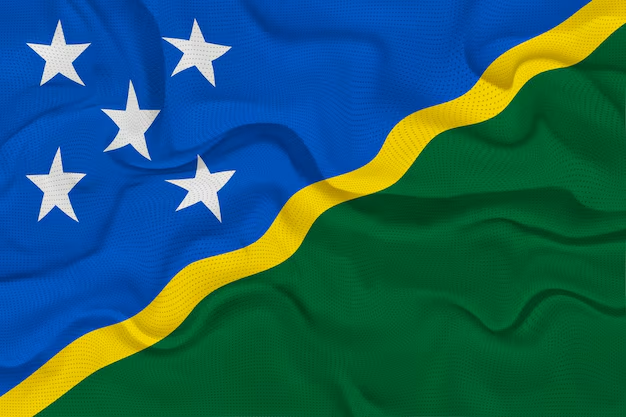
Solomon Islands’ Political System: Constitutional Monarchy

juteralabs.com – The Solomon Islands, an independent Commonwealth realm located in the South Pacific, operates under a constitutional monarchy with a Westminster-style parliamentary democracy. This unique political system combines elements of traditional monarchy with modern democratic principles, ensuring a balance of power among various governmental institutions.

Constitutional Framework

The political system of the Solomon Islands is rooted in its constitution, which was established upon independence from the United Kingdom on July 7, 1978. The constitution outlines the framework for a parliamentary democracy, where the British monarch serves as the formal head of state, represented by a governor-general appointed by the monarch on the advice of the prime minister.

Executive Branch

The executive power in the Solomon Islands is vested in the government, which is headed by the prime minister. The prime minister is typically the leader of the majority party or coalition in the National Parliament and is responsible for forming the cabinet. The governor-general, acting on the advice of the prime minister, appoints the chief justice of the Supreme Court and other key officials.

Legislative Branch

The legislative branch of the Solomon Islands is unicameral, consisting of the National Parliament. The parliament comprises 50 members elected for a four-year term in single-seat constituencies. This body is responsible for enacting laws and overseeing the work of the executive branch. The parliament operates under a multi-party system, which often leads to unstable coalitions and frequent changes in government leadership.

Judicial Branch

The judicial system in the Solomon Islands is based on British common law. The Supreme Court, also known as the National Court, is the highest court in the country. It is composed of the chief justice and other judges appointed by the governor-general on the advice of the prime minister. Below the Supreme Court are the High Court and the Magistrates’ Courts, which handle various legal matters across the country.

Local Government

The Solomon Islands is divided into 10 administrative areas, nine of which are provinces administered by elected provincial governments. These local governments have significant autonomy in managing local affairs, including education, health, and infrastructure development. This three-tiered system of government ensures that local needs are addressed while maintaining national unity.

Political Stability and Challenges

The political landscape of the Solomon Islands is characterized by weak political parties and highly unstable parliamentary coalitions. Frequent votes of no confidence and changes in government leadership are common, reflecting the challenges of maintaining political stability in a multi-party system. Despite these challenges, the country continues to uphold its democratic principles and constitutional framework.

Conclusion

The political system of the Solomon Islands, as a constitutional monarchy with a Westminster-style parliamentary democracy, provides a unique blend of traditional and modern governance. While it faces challenges in maintaining political stability, the system ensures a balance of power and representation, reflecting the country’s commitment to democratic principles and constitutional governance.

Governance and Leadership: Kiribati’s Political System

juteralabs.com – Kiribati, a republic in the central Pacific Ocean, has a unique political system that reflects its cultural heritage and historical experiences. This article delves into the governance structure and leadership dynamics within Kiribati, providing an overview of its political landscape.

The Constitution and Government Structure

The foundation of Kiribati’s political system is its constitution, which was enacted at the time of independence in 1979. The constitution establishes Kiribati as a sovereign democratic republic, with a government structure that combines elements of traditional governance and modern democratic principles.

The government of Kiribati is divided into three branches: the executive, the legislative, and the judicial. This separation of powers ensures a balanced system of governance, with each branch having distinct roles and responsibilities.

The Executive Branch

The executive branch is headed by the President of Kiribati, who is both the head of state and the head of government. The President is elected by an electoral college, which consists of members of the House of Assembly and representatives from the outer islands. The President serves a four-year term and is limited to two consecutive terms.

The President appoints a Cabinet, which includes ministers responsible for various government departments. The Cabinet is accountable to the President and plays a crucial role in the formulation and implementation of government policies.

The Legislative Branch

The legislative branch is composed of the House of Assembly, Kiribati’s unicameral parliament. The House of Assembly consists of 45 members, who are elected through a unique electoral system that combines single-member constituencies and multi-member constituencies. Members serve four-year terms.

The House of Assembly is responsible for enacting laws, approving the national budget, and overseeing the executive branch. The Speaker of the House, elected by its members, presides over parliamentary sessions and ensures the smooth functioning of the legislative process.

The Judicial Branch

The judicial branch is independent of the executive and legislative branches, ensuring the rule of law and the protection of individual rights. The court system in Kiribati includes the High Court, the Court of Appeal, and the Supreme Court. The Chief Justice, appointed by the President, heads the judiciary.

Traditional Governance and Modern Politics

Kiribati’s political system also incorporates elements of traditional governance, known as “maneaba” culture. The maneaba is a traditional meeting house where community decisions are made through consensus. This model of inclusive decision-making influences modern political processes, promoting dialogue and consensus-building among political leaders and citizens.

Leadership and Political Dynamics

Leadership in Kiribati is characterized by a blend of traditional authority and modern political acumen. Political leaders often draw on their understanding of Kiribati’s cultural values and social norms to navigate political challenges and foster national unity.

Political parties in Kiribati are relatively fluid, with alliances and coalitions forming and dissolving based on political expediency and shared policy objectives. This dynamic political landscape reflects the adaptability and resilience of Kiribati’s political system.

Conclusion

Kiribati’s political system is a testament to the nation’s ability to blend traditional governance with modern democratic principles. The constitution, government structure, and leadership dynamics reflect a commitment to democratic values, while also honoring the cultural heritage of the Kiribati people. As Kiribati continues to evolve, its political system will play a crucial role in shaping the nation’s future, ensuring stability, and promoting the well-being of its citizens.